
Body Mass Index (BMI) is one of the most popular tools used worldwide to assess whether your weight is healthy for your height. Whether you’re tracking fitness progress, preparing for a medical check-up, or simply curious about your health, knowing how to calculate BMI is a useful skill.
In this complete guide, you’ll learn the exact formulas, step-by-step methods (metric & imperial), real examples, BMI categories, and important limitations of BMI in 2026.
BMI (Body Mass Index) is a simple calculation that uses your height and weight to estimate body fat levels. It is widely used by doctors, the CDC, and the World Health Organization as a quick screening tool.
While BMI doesn’t directly measure body fat or overall health, it provides a fast and helpful starting point for most adults.
There are two standard formulas depending on the units you prefer:

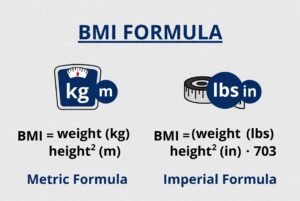
BMI = weight (kg) ÷ [height (m)]²
BMI = [weight (lbs) ÷ (height (in))²] × 703
Both formulas give accurate results when used correctly.

Person: Weight = 70 kg | Height = 1.70 m
Step 1: Square your height 1.70 × 1.70 = 2.89
Step 2: Divide weight by height squared 70 ÷ 2.89 = 24.22
Result: BMI = 24.22 → Healthy Weight
Person: Weight = 165 lbs | Height = 5’8″ (68 inches)
Step 1: Square your height 68 × 68 = 4,624
Step 2: Divide weight by height squared 165 ÷ 4,624 = 0.0357
Step 3: Multiply by 703 0.0357 × 703 = 25.1
Result: BMI = 25.1 → Overweight range
Fastest Method: Use our free BMI Calculator for instant and accurate results.

| BMI Range | Category | Health Risk |
|---|---|---|
| Below 18.5 | Underweight | Increased |
| 18.5 – 24.9 | Healthy Weight | Lowest |
| 25.0 – 29.9 | Overweight | Increased |
| 30.0 – 34.9 | Obesity Class 1 | High |
| 35.0 – 39.9 | Obesity Class 2 | Very High |
| 40.0 and above | Obesity Class 3 (Severe) | Extremely High |
These categories apply to adults aged 20 and older.

While BMI is useful, it has several well-known limitations:
Bottom line: Use BMI as a starting point, not the final answer.
For a more complete picture of your health, combine BMI with these tools:
| Tool | What It Measures | Link |
|---|---|---|
| BMI Calculator | Weight relative to height | Main Tool |
| BMR Calculator | Calories burned at rest | BMR Calculator |
| Ideal Weight Calculator | Healthy weight range | Ideal Weight |
| Body Fat Calculator | Actual body fat percentage | Body Fat Calculator |
| Macro Calculator | Daily protein, carbs & fat needs | Macro Calculator |
How do I calculate BMI quickly? Use our free online BMI Calculator. It supports both metric and imperial units.
Is the BMI formula the same for men and women? Yes, the formula is identical. However, women generally have higher body fat percentages than men at the same BMI.
Can I have a high BMI but still be healthy? Yes. Muscular individuals often have higher BMIs while maintaining excellent health. This is one of BMI’s biggest limitations.
How often should I check my BMI? Most people check every 4–6 weeks when actively working toward a goal.
Does BMI work during pregnancy? No. Use pregnancy-specific tools and consult your doctor. See our Pregnancy Calculator.
What’s the difference between BMI and BMR? BMI measures weight status. BMR calculates calories burned at rest. Most people track both together.
BMI remains a valuable screening tool, but it should be used alongside other metrics for the best results. Now that you know exactly how to calculate BMI, you can track your progress more effectively.
Ready to check your numbers?